
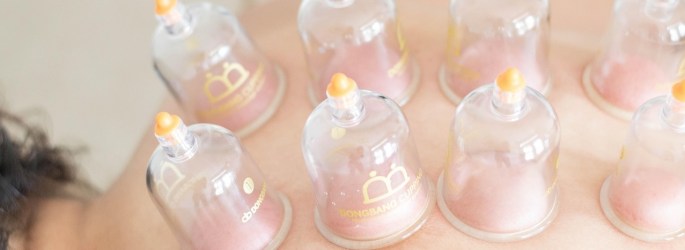
Once used in traditional healing practices across the globe, cupping is now recognised as a powerful tool in soft tissue therapy. By creating suction on the skin, it helps release tension, improve blood flow, and target areas of tightness—especially in the fascia, the connective tissue that supports organs, muscles, and movement. Whether you’re dealing with stiffness, restricted range of motion, or lingering muscle soreness, cupping can offer a gentle yet effective way to help your body move and feel better.
Cupping and its History

Cupping is a form of alternative therapy that originated in China and the Middle East. It uses glass cups that are gently suctioned onto the skin along the meridians of the body, creating an effect that ‘pulls’ tissue upward, increasing blood flow and promoting muscle relaxation.
The exact origins of cupping are unknown; however, cupping has been in use for centuries across many cultures. Ancient Greek physician Hippocrates used cupping to treat internal and structural issues, and Roman surgeons also utilised the practice. The Islamic Prophet Muhammad recommended cupping, leading Muslim scholars to develop and spread the technique throughout Asia and Europe. It also appears in historical Jewish medical texts.
In China, cupping dates to the 3rd century AD with Taoist herbalist Ge Hong. Since the 1950s, cupping has been widely used in Chinese hospitals as part of traditional medicine—highlighting its long-lasting role in healing. In recent years, cupping has been gaining popularity in the West as a helpful and healing complementary therapy for muscular issues, especially as a form of myofascial release.
The Role of Cupping as Myofascial Release
Myofascial release is a form of physical therapy used to relieve stiffness and address restrictions in myofascial tissue—‘fascia’. Fascia is the thin layer of connective tissues that surrounds the muscles and organs of the body. When healthy, fascia help hold the structure of your body in place and help with ease of movement. Over time, if you’re not active enough or don’t engage in a full range of movement, fascia can get accustomed to a restricted range of motion. This can result in fascia that is less flexible and prone to micro-adhesions, which in turn can restrict range of motion further.
Cupping as a form of myofascial release can work on these micro-adhesions to help stretch fascia, increase blood flow, encourage healing, and increase range of motion. Cupping also works deep in the tissue—it creates a ‘pulling’ action that takes place about 2cm below the surface of your skin—offering a unique release when compared to massage. While massage works by gently pushing into the muscles to release tension, cupping does the opposite—it lifts the tissue upward. When used together, this push-pull combination helps target tightness from both directions.
Cupping in Remedial Massage: What to Expect

So, when might cupping be used in addition to massage?
Cupping is especially useful for clients with presentations involving:
- Tightness
- Limited range of motion
- Ligament injuries
When combining cupping with remedial massage, cups will typically be applied both before and after the massage, for about 5-10 minutes at a time. When used therapeutically, cupping is often very targeted, with cups applied only to the specific areas that need attention.
In some cases, deep red marks may occur where the cups were placed. This is a completely normal part of the cupping process and to be expected. These marks may look like bruises, but they are skin discolorations caused by blood being drawn to the surface and increased circulation. They usually fade within two weeks and can even be a good sign that the body is responding well to treatment, helping speed up fascia recovery in the area.
What does a typical cupping + remedial massage session look like?
A typical session combining cupping and remedial massage is 90 minutes long—with 5-10 mins of cupping either side of the remedial massage. Incorporating cupping as part of a remedial massage allows your massage therapist to maximise its benefits—helping to soften tight tissue, improve circulation, and release fascial restrictions.
Cupping can also be combined with infrared sauna for increased benefits; however, since sauna isn’t for everyone, cupping can be a great alternative for relaxing tight muscles without the heat. It allows your massage therapist to tailor the treatment to what you’re most comfortable with—making cupping a suitable choice when the issue isn’t too severe or when heat therapy isn’t preferred.
To summarise, cupping is an invaluable tool in soft tissue therapy—helping to relax and stretch fascia—increasing range of motion and promoting healing. Its benefits in remedial massage are vast, from treating limited range of motion to addressing broader issues like general muscle tightness. Results are fairly immediate, with many clients reporting instant improvements in range of motion. If you’re curious or dealing with restricted movement or muscle tightness, talk to us about cupping. It might just give you the release you’ve been looking for.
This article is part two in a three-part series about the therapeutic techniques we use here at Transcend Health and Well-Being to assist those with a limited range of motion. Our first article was about the benefits of infrared sauna. Be sure to keep tabs on our posts to read part three!
 transcendhealthwellbeing.com.au